RAG vs GraphRAG: Which AI Retrieval Architecture is Best?
Explore the definitive comparison between RAG and GraphRAG. Learn about their architectures, use cases, and performance to choose the right one for your AI pro…
The Critical Choice in Modern AI Architecture
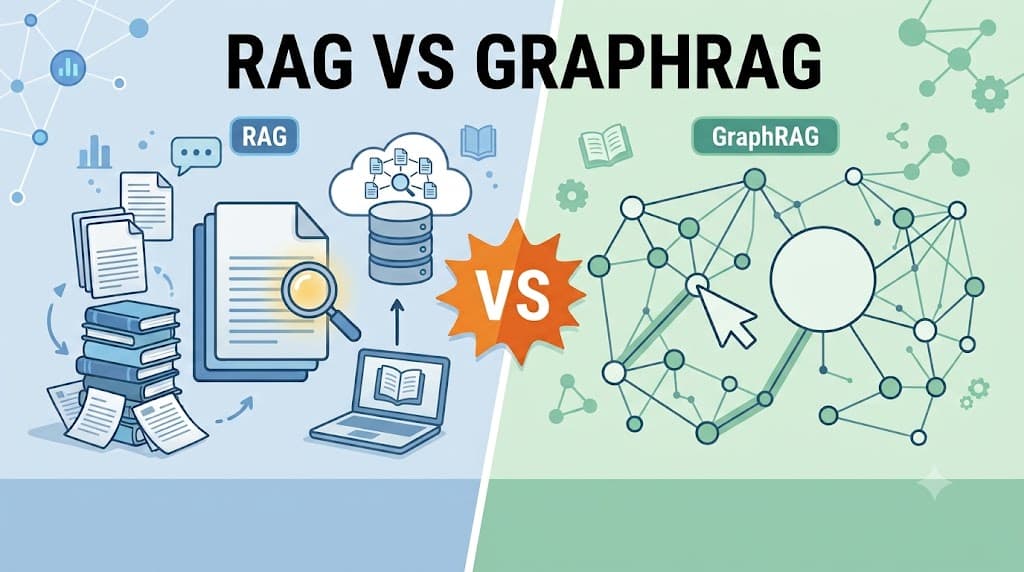
Choosing between Retrieval-Augmented Generation (RAG) and its sophisticated successor, GraphRAG, is one of the most critical architectural decisions for AI developers in 2024 and beyond. It's a choice between retrieving isolated facts and understanding interconnected knowledge. The header image perfectly illustrates this divide: on the left, classic RAG sifts through stacks of documents, finding relevant passages. On the right, GraphRAG navigates a web of relationships, connecting disparate pieces of information to form a coherent whole.
The Rise of Retrieval-Augmented AI
Enterprise RAG Adoption by 2025
Projected adoption rate in Fortune 500 companies.
GenAI Market Size (RAG-inclusive)
Projected market value by 2026, with RAG being a key driver.
Accuracy Boost over Base LLMs
Average improvement in factual accuracy when using RAG.
Deconstructing Classic RAG: The Document-First Approach
At its core, classic RAG is a mechanism to ground a Large Language Model (LLM) in factual, up-to-date information, reducing hallucinations and enabling it to answer questions about private data. The process is linear and can be broken down into three main phases: Indexing, Retrieval, and Augmentation.
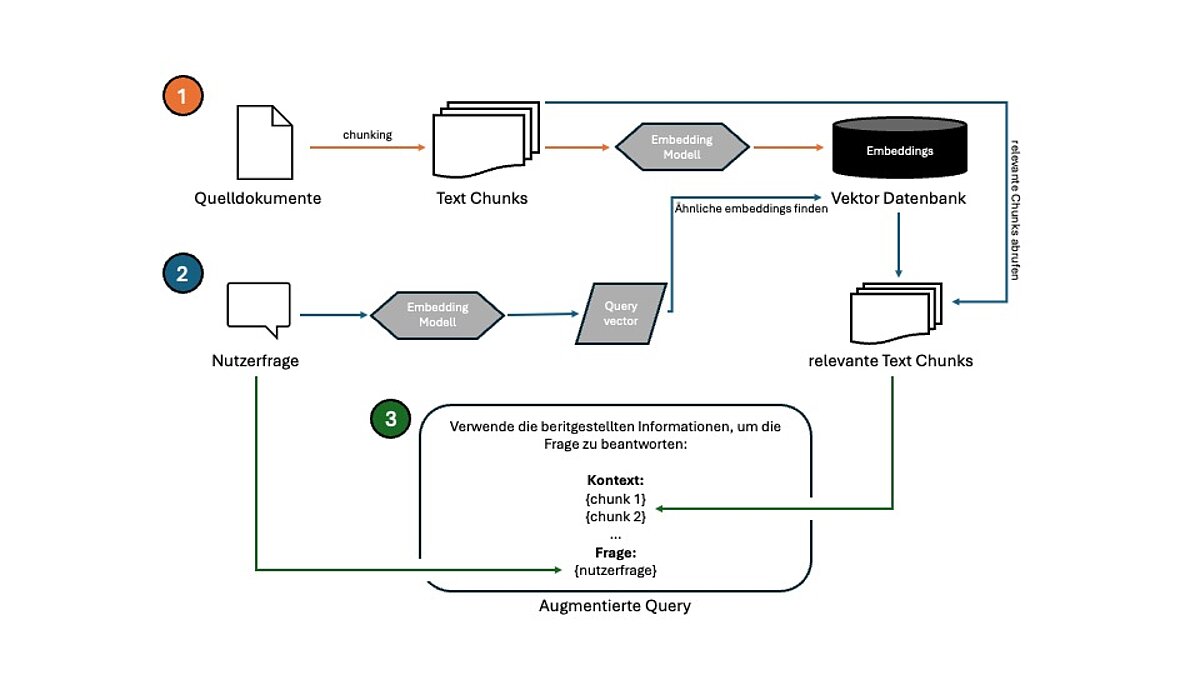
As the infographic above illustrates, the journey begins by processing source documents. In the Indexing phase (①), documents are broken into smaller 'chunks'. Each chunk is then converted into a numerical representation—an embedding—by an embedding model and stored in a vector database. During the Query phase (②), the user's question is also converted into an embedding. The system then performs a similarity search in the vector database to find the document chunks whose embeddings are 'closest' to the query's embedding. Finally, in the Augmentation phase (③), these retrieved chunks are combined with the original question to form an augmented prompt, which is then sent to the LLM to generate a grounded answer.
The 3 Phases of a RAG Query
Indexing
Source documents are chunked, embedded, and stored in a vector database for fast retrieval.
Retrieval
A user query is embedded and used to find the most semantically similar chunks via vector search.
Augmentation & Generation
Retrieved chunks are added to the user query as context, and the LLM generates an answer based on this information.
The Limit of Semantic Similarity
Embeddings measure semantic proximity in vector space, usually via cosine similarity. This is excellent for finding text with similar meaning. However, it fails when an answer requires connecting information across multiple, seemingly unrelated documents (multi-hop reasoning) or understanding the global structure of the knowledge base.
Enter GraphRAG: Connecting the Dots
Instead of just processing data as isolated text chunks, GraphRAG enhances the search process with a so-called Knowledge Graph. The system doesn't just memorize isolated facts; rather, it specifically models how these entities relate to one another. Its true strength lies in its ability to correctly interpret interconnected or narrative data.
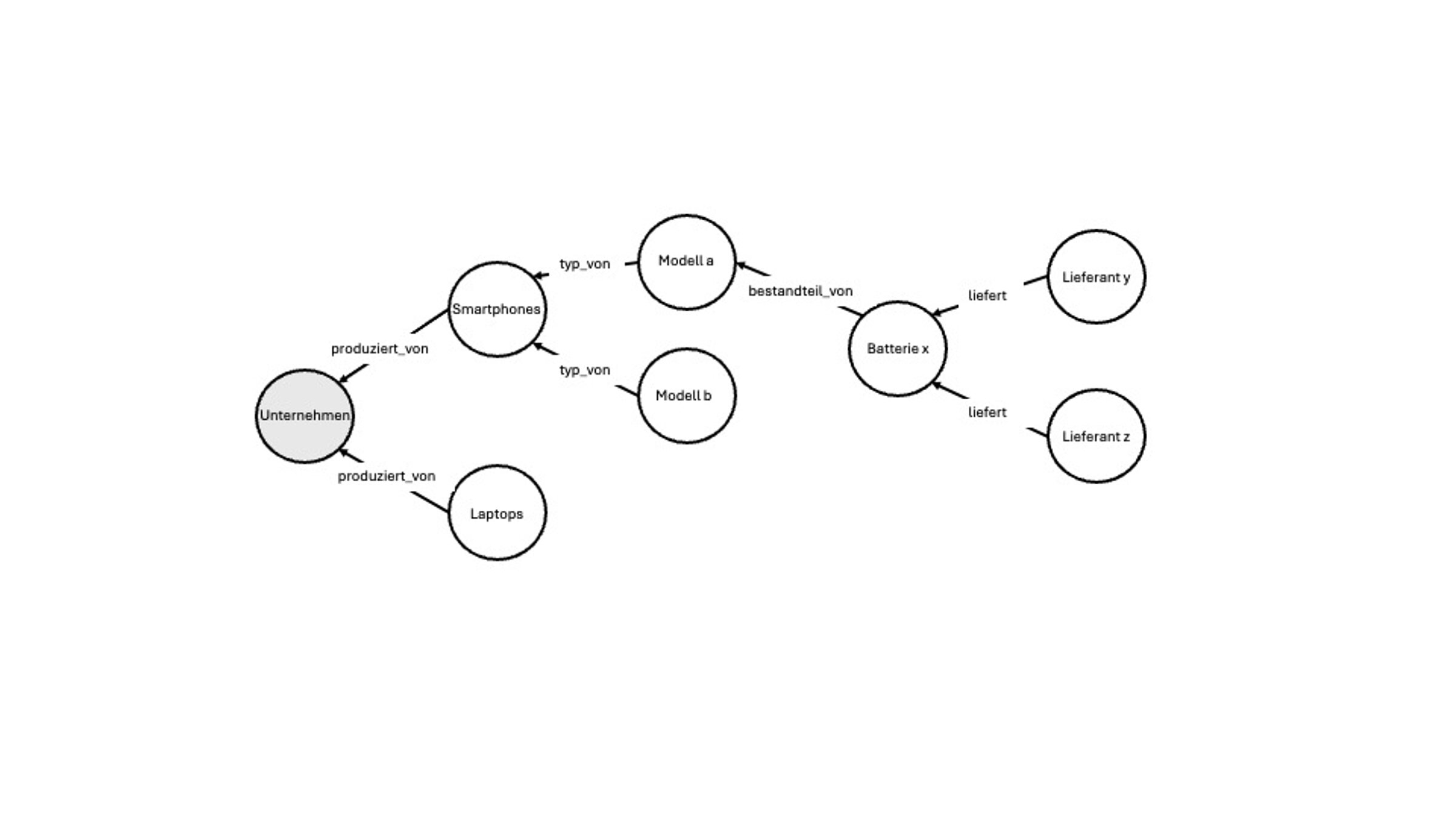
The best way to picture GraphRAG is as a massive, intelligent mind map. In this mind map, there are nodes (the individual objects, people, or concepts) and connections (the lines between them that describe exactly how everything is linked).
Let's take a tech company as an example: In our mind map, there is a central node for the company. From there, an arrow labeled "produces" points to the category of smartphones. The smartphone category then branches out into various models, which are made up of specific components like a battery. From this battery, another arrow points to the respective suppliers.
Because GraphRAG is aware of this entire network of relationships, it instantly understands the logical path from the battery supplier all the way to the company's finished smartphone. This allows the system to comprehend complex correlations and provide answers that would have otherwise required you to painstakingly sift through and manually connect countless individual documents yourself.
Head-to-Head: RAG vs. GraphRAG
The choice between these two architectures involves a trade-off across several dimensions, from complexity and cost to the types of questions each can answer.
Architecture Showdown: RAG vs. GraphRAG
""Vector search finds similar sentences—not connected truths. To answer complex questions, you need to traverse the graph of knowledge."
Retrieval Approach Comparison
| Feature | Classical RAG | Advanced RAG | GraphRAG | HybridBest |
|---|---|---|---|---|
| Setup Effort | ||||
| Reasoning Depth | ||||
| Infrastructure Cost | ||||
| Community Maturity | ||||
| Production-Ready |
Performance & Benchmarks: A Data-Driven View
Theory is one thing, but performance is what matters in production. Benchmarks from sources like Microsoft's GraphRAG paper and the RAGAS framework show a clear trade-off between speed, cost, and reasoning capability.
Retrieval Architecture Strengths
RAG: Speed
RAG: Cost-Efficiency
GraphRAG: Precision
GraphRAG: Reasoning Depth
Recall (Both)
The radar chart highlights the core strengths: Classic RAG is optimized for speed and cost, making it ideal for real-time applications. GraphRAG, while slower and more expensive, provides unparalleled precision and depth for complex analytical queries. Both approaches can achieve high recall, but GraphRAG often finds more relevant information by understanding context.
Accuracy vs. Latency of Retrieval Methods
Decision Guide: When to Use RAG vs. GraphRAG
The right choice depends entirely on your use case, data structure, and performance requirements. Don't chase the most complex solution; choose the simplest one that solves your problem effectively.
Use-Case Suitability
Avoid Over-Engineering
A common pitfall is deploying GraphRAG for problems that a simple vector-search RAG could solve. This leads to unnecessary costs, higher latency, and a significant maintenance burden. If your users are asking simple questions, start with simple RAG.
Implementation & Tooling Landscape
The ecosystem for both RAG and GraphRAG is maturing rapidly. Frameworks like LangChain, LlamaIndex, and Haystack provide robust building blocks for RAG, while graph databases like Neo4j and Microsoft's own GraphRAG library are leading the charge for connected data retrieval.
Key Tooling Popularity (GitHub Stars, est. 2025)
The Hybrid Approach: Best of Both Worlds
The most sophisticated systems don't choose one or the other. They use a router or an agentic approach to analyze the incoming query. Simple, factual questions are sent to a fast, low-cost RAG pipeline. Complex, multi-hop questions are routed to the more powerful GraphRAG engine. This optimizes both performance and cost.
Build Your Next-Gen AI on the Right Foundation
The future is not 'RAG or GraphRAG,' but 'which architecture for which problem.' Let our experts help you design a retrieval system that is powerful, scalable, and cost-effective.
Get Your AI Strategy Consultation